Cassandra: A Case Study of Hysteria? (2/5) – The Strangulated Affect
In the first part of this series, we identified an event in Cassandra’s past that can undoubtedly be termed a “psychic trauma,” as it is actively reproduced within the tragedy. In this post, we turn our attention to another core component of hysteria: unexpressed affect.
The Adequate Reaction
The affect constitutes the focal point of healing hysterical symptoms in Freud’s texts. What leads to hysterical symptoms is to a lesser extent the trauma itself, but rather the affect attached to it which was not adequately abreacted. Conversely, Freud achieved the healing of hysterical symptoms when he succeeded in bringing to consciousness the memory of the trauma and by “arousing its accompanying affect, and when the patient had described that event in the greatest possible detail and had put the affect into words.”1
Later on, Freud describes the discharge of the affect more precisely. The pivotal question is whether there has been an “energetic” reaction to the event. Freud refers here to a number of reflexes that discharge an affect,”from tears to acts of revenge.”2 Only when this reaction ensues in an adequate measure, is the affect discharged. If the reaction is stifled, it will remain attached to the memory and later on lead to hysterical symptoms. Freud himself points to language, which contains specific terms for this process of discharge. Even for us in the 21st century, it stands to reason that feelings must be channeled from our inner world into the outside world—in a constructive manner, of course—in order to be processed. What remains unspoken, festers within.
This concise rendering of Freud’s remarks shall be sufficient for our purpose, even though Freud wrote considerably more about the treatment of psychic trauma. I will elaborate on these remarks at a later point. I would like to mention an additional quote which serves as the foundation for this post and also encapsulates what has been described above.
The injured person’s reaction to the trauma only exercises a completely ‘cathartic’ effect if it is an adequate reaction—as, for instance, revenge.3
Where Does the Strangulated Affect Show?
Thus, our question is the following: Are there traces of a strangulated affect to be found in Cassandra’s appearance? And does an adequate reaction follow? I would like to expand this question to encompass the entire tragedy. I am aware that this series deals with hysterical elements of Cassandra’s appearance. However, this appearance is directly attached to the premise of the tragedy, because the punishment of the Greeks constitutes the climax of the “plot.” We ask these questions concerning both Cassandra’s appearance and the entire tragedy. As we shall see, the concept of an “adequate reaction” is strongly rooted in the tragedy. Furthermore, it shall be noted that the search for a strangulated affect takes place retroactively. As we saw with the precipitating trauma, we are only able to identify the strangulated affect from the standpoint of the present. Therefore, we need to look out for dynamics that seek to abreact this affect. Only in this way can we identify the strangulated affect. To some extent, hysterical symptoms constitute the misguided attempt to abreact this affect. Freud only works this out later as part of his concept of the repetition compulsion, but he hints at this in his Studies.
Three distinct sites can be identified where the strangulated affect comes to light: Cassandra’s argumentation, the process of mourning within the tragedy, and the premise of the tragedy itself. Let us begin with the first.
First Location: Cassandra’s argumentation
We have already established that Cassandra’s appearance is divided into an ecstatic and an argumentative section. We may approach the concept of a strangulated affect through this argumentative section. As we already know, Cassandra tries to explain to her mother that the Trojans are the true victors of the war. But why does she even try to do so? Here, I would like to frame my argument in terms of the “adequate reaction.” Let us take a look into the tragedy itself.
Looking at the very structure of the tragedy, the positioning of her appearance is highly interesting. First, Hecuba successfully animates the chorus to sing a lament together for fallen Troy, which only falls silent when Talthybius enters the stage and informs Hecuba about the women’s fate. In this moment of grief, terror and fateful submission, Cassandra suddenly appears, singing her wedding song. Enough has already been said regarding the content. After this wedding song, the argumentative section of her speech (365) commences. Viewed from the outside, there are plenty of reasons why she brings forward this line of argument in the first place. From a dramaturgical perspective, Euripides emphasizes Cassandra’s madness—at least in the eyes of Hecuba and Talthybius. The audience knows that her argumentation is, admittedly, out of place, but still holds a kernel of truth. Many more dramaturgical reasons could be found to justify the positioning of Cassandra’s appearance. But can we find reasons that lie strictly within the internal logic of the tragedy?
Yes, they do exist, and Cassandra herself tells us as much. She concludes her argument in the following way:
Therefore, mother, you ought not to pity our
country or my marriage bed. With my marriage I shall destroy
those you and I hate most. (403-05)4
It is at exactly this juncture where we find the concept of an “adequate reaction.” Cassandra argues in favor of the Trojans because she deems her mother’s reaction to be inadequate. From Cassandra’s perspective, there exists absolutely no reason to grieve, because the fate of the Greeks will turn. It is, of course, a different matter entirely that Hecuba is blind to this fact and therefore considers her daughter insane. From Cassandra’s viewpoint, the adequate reaction to the trauma (Troy’s destruction) is not grief but elation. Through this perspective, we are able to catch a glimpse of a strangulated affect. In her entrance, there exists a dimension that is trying to find an adequate reaction to her lived experience. Interestingly, this same dimension exists in the interpretation of her appearance. Note the choice of words by Brillet-Dubois, who writes about Cassandra’s appearance:
As we saw earlier in the prologue, the old queen successfully took the lead of the lamenting chorus; but because Cassandra deems inappropriate the songs of sorrow with which she responds to the situation, she attempts to replace her mother’s cries of pain with cries of joy […].5
Of course, the Freudian concept of a strangulated affect is not fully met here; it is, in fact, only gently touched upon. Nevertheless, I found this detail worth mentioning, since the center of the “conflict” between Cassandra and Hecuba is precisely the adequacy of the reaction to a (traumatic) experience. Now, let us turn to the second location of our inquiry.
Second Location: Grief as a Reaction?
Before I turn to the central focus of this post, we shall examine another detail that also touches on the strangulated affect, namely grief. This concept has a far-reaching history in psychology and has brought countless theories to light: from Sigmund Freud’s distinction between mourning and melancholia, to John Bowlby and Mary Ainsworth’s nowadays highly popular (and misunderstood) attachment theory, all the way to Kübler-Ross’s universally known (and controversial!) five stages of grief. Although these theories partly stem from different schools of thought, they intersect in several aspects. From a layperson’s perspective, this mountain of different theories seems almost insurmountable. Luckily, during my research, I came across an essay that sheds light on the concept of grief not in psychological but in philological terms. I would like to attempt to connect the insights of this essay with the concept of the adequate reaction.
Ann Suter’s essay is based on an unpublished dissertation by Elinor Wright, in which Wright describes objective criteria of lament in ancient Greek tragedies. These criteria are of a textual and philological nature; she names certain rhetorical devices, themes, and metrical patterns that repeatedly appear in laments. Ann Suter applies these criteria to The Trojan Women and comes to the conclusion that almost every scene contains elements of lament. So much for a short summary that does not do justice to the depth of the essay. I highly recommend reading it in full. In the following, I would like to single out certain passages and illustrate how they can be connected to the topic of this post.
Suter names certain topoi of lament. These include the “expression of grief and loss, a contrast between past and present, praise for the dead, anger at the dead for abandoning the bereaved, and—highly relevant for our purposes—anger at and a desire for vengeance on those responsible for the death.”6 Here, the “cathartic effect” of an adequate reaction—as mentioned by Freud—already begins to emerge. This becomes even clearer later in the text:
Reconciliation may require various things, depending on the circumstances of the death: accceptance, forgiveness, vengeance. The contradictory purposes that sometimes emerge from the twin impulses to reconciliation and to revenge are a part of many laments.7
Not only does vengeance seem to be a part of grief, but ancient drama seems to be aware of the inherent contradictoriness between revenge and reconciliation. To illustrate this, consider the following: If we assume that the tragedy is—based on a set of critera—comprised for the most part of lament (and Suter supplies ample evidence for this), then the concept of an adequate reaction always resonates throughout the tragedy. Cassandra herself does not provide lament, but she touches upon this concept.
At 443 Cassandra changes suddenly into trochaic tetrameter, with an increase in emotional intensity as she delivers her strange prophecy about Odysseus, and recalls her impending death in a then/now description (446-50). This change parallels the progression that we find in full laments from an iambic meter to another meter, with the same heightening of emotion.8
Because Cassandra is embedded in this holistic grieving process, and to some extent touches on this, Euripides implicitly raises the question of the adequate reaction. This also shows us that grief can be a viable response to the events that transpired. Consequently, further questions might follow: What does Euripides want to tell us? Is grief an adequate reaction? Or is it the path Cassandra chooses to take? This excursion into grief has shown us that an unprocessed affect lies concealed within both hysteria and mourning. In both cases, the central issue is that of adequate processing.
Third Location: Sacrilege and its Punishment
Let us now turn to the central point of this post. I believe that the entire conception of the tragedy is linked with the question of the adequate response. Rather, it poses precisely this question: What even is adequate? Grief? Rage? Resignation? The entire premise—and, with it, the entire “plot”—hinges on this question. To arrive at this realization, no considerable act of interpretation is needed. Athena herself tells us as much in line 71.
Athena: Are you not aware that I and my temples have been treated with contempt?
Poseidon: Yes: it was when Ajax dragged Cassandra off by force.
Athena: And he was in no way punished or censured by the Achaeans. (69-71)
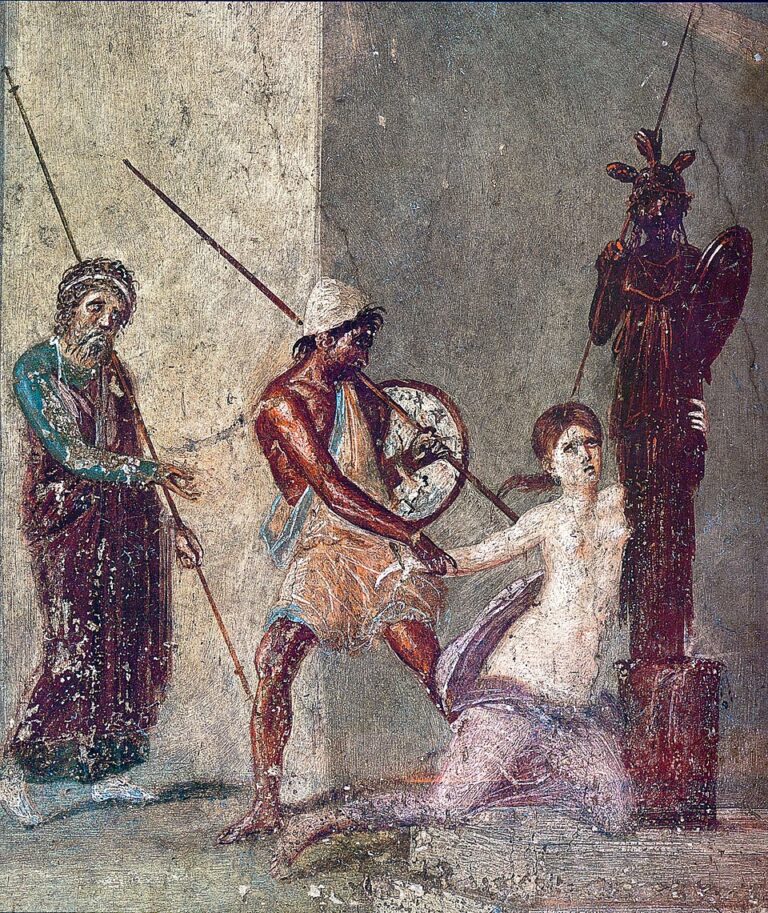
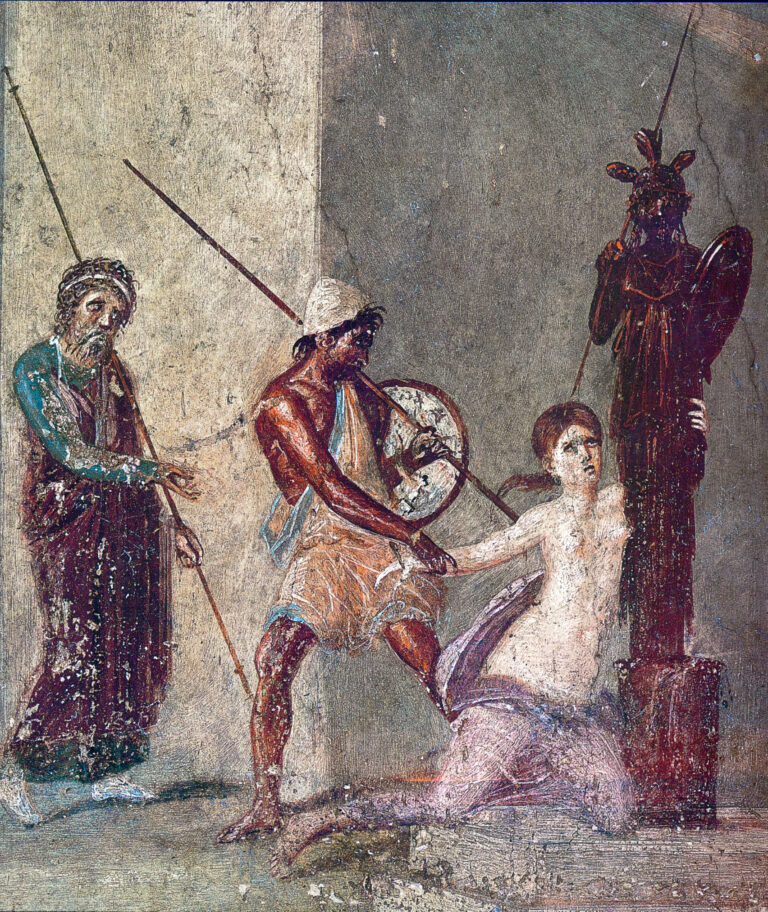
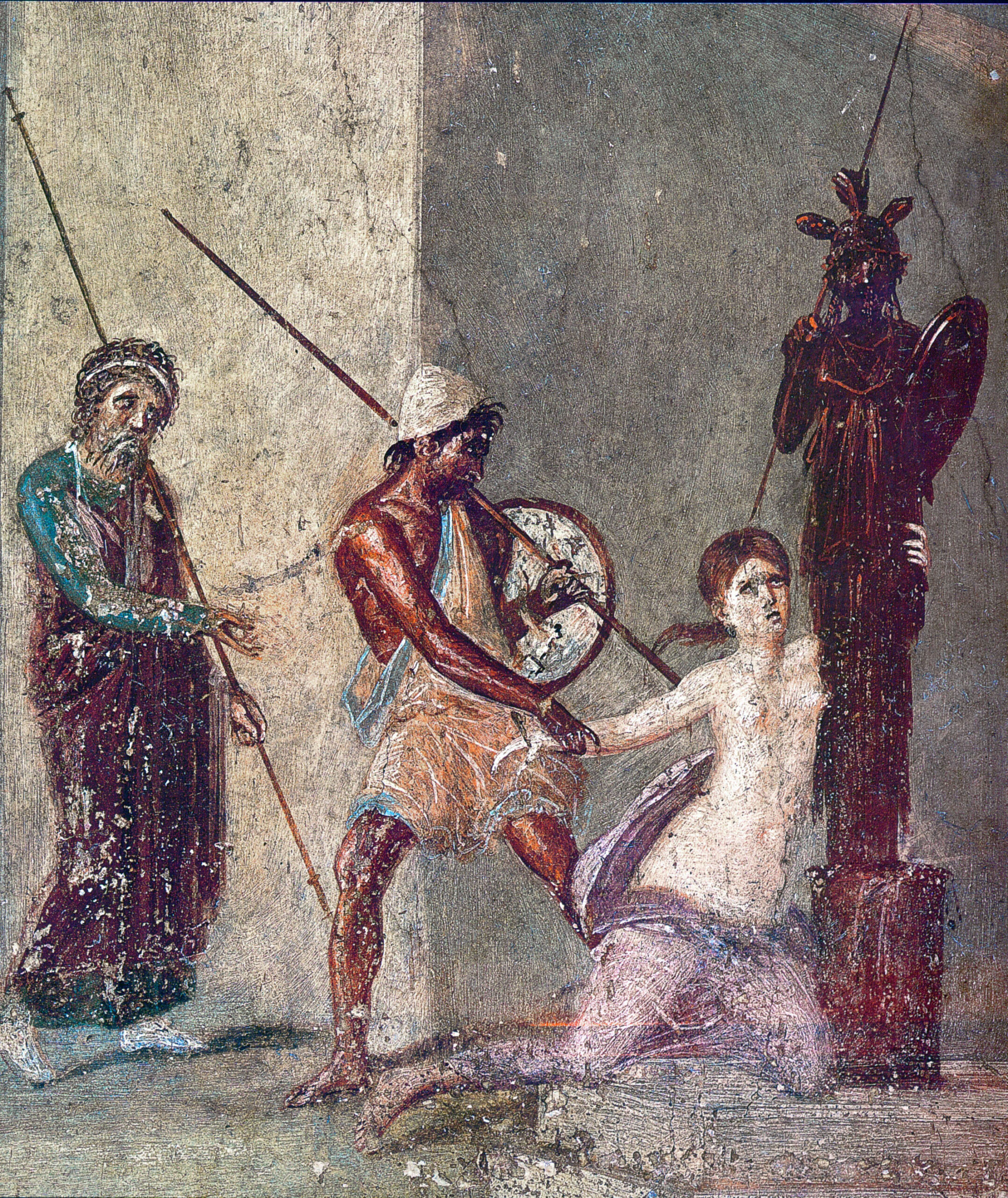
That is precisely Athena’s point. It is not the deed itself that demands punishment; rather, it is the absent reaction. Who is to deliver this missing response? Cassandra.
If the affect remains suppressed at the moment of the rape, it surfaces through Cassandra’s entrance. Her singular goal becomes the destruction of the Greeks, brought about by her marriage to Agamemnon. It is exactly this destruction (or “plundering” to use Kovacs’ term) that can be interpreted as an adequate reaction because it sets in motion the divine plan. Technically speaking, Euripides outsources the absent reaction to the Greeks and does not allow it to dwell within the character of Cassandra, yet it remains deeply intertwined with her person.
Psychoanalytically speaking, the entire purpose of this tragedy is to find an adequate response to the trauma. While the other characters remain unable to deliver a reaction, it is Cassandra who—with all her might—strives to process the strangulated affect. In response to the sacrilege committed in Athena’s sanctuary, only the downfall of the Greeks can be deemed truly adequate. Interestingly enough, Euripides chooses Cassandra to capture this psychological nuance.
Conclusion
What we found is that the search for an adequate reaction is deeply ingrained in the tragedy. Cassandra’s appearance is marked by attempts to find an adequate response. Her argumentation rejects Hecuba’s grief and instead demands joy. Yet, the truly adequate reaction lies deeper within; it is the destruction of the Greeks, who were never punished for the sacrilege committed by Ajax. Cassandra thus turns into the very instrument of this response.
The entire tragedy circles around this question: What is the adequate response? Euripides offers grief (Hecuba, the Chorus), vengeance (Athena, Cassandra) and even resignation (Andromache)—but leaves this question unanswered. Assessing the adequacy of this response was not the purpose of this post; that is for the audience to decide. This post merely demonstrated that it is precisely this question that lies at the very heart of The Trojan Women.
Cassandra’s paradoxical joy as a form of revenge—is this a psychologically coherent abreaction or a purely literary hyperbole by Euripides? I am interested in your assessment: can an affect ever truly be “adequate” when the underlying event shatters all norms?
Cassandra: A Case Study of Hysteria?
This post is part of my six-part series on Cassandra’s appearance in Euripides’ The Trojan Women:
- Part 0 (Primer): Why is Cassandra dancing?
- Part 1: Cassandra’s Trauma
- Part 2: The Strangulated Affect [You are here]
- Part 3: The Physical Symptoms
- Part 4: The Field of Sexual Experience
- Part 5: Conclusion
Sign up here to receive the latest essays on Euripides, psychology, and history directly in your inbox:
- Sigmund Freud and Josef Breuer, Studies on Hysteria, trans. James Strachey (London: Hogarth Press, 1955), 6.
- Freud & Breuer, Studies on Hysteria, 8.
- Freud & Breuer, Studies on Hysteria, 8.
- Unless otherwise specified, all citations refer to the Loeb edition of Euripides’ Trojan Women (ed. and transl. David Kovacs, Harvard University Press, 1999).
- Pascale Brillet-Dubois, “A Competition of Choregoi in Euripides’ Trojan Women: Dramatic Structure and Intertextuality,” Lexis: Poetica, retorica e comunicazione della tradizione classica 33 (2015): 176.
- Ann Suter, “Lament in Euripides’ Trojan Women,” Mnemosyne 56, no. 1 (2003): 3
- Suter, “Lament in Euripides’ Trojan Women,” 11.
- Suter, “Lament in Euripides’ Trojan Women, 9.