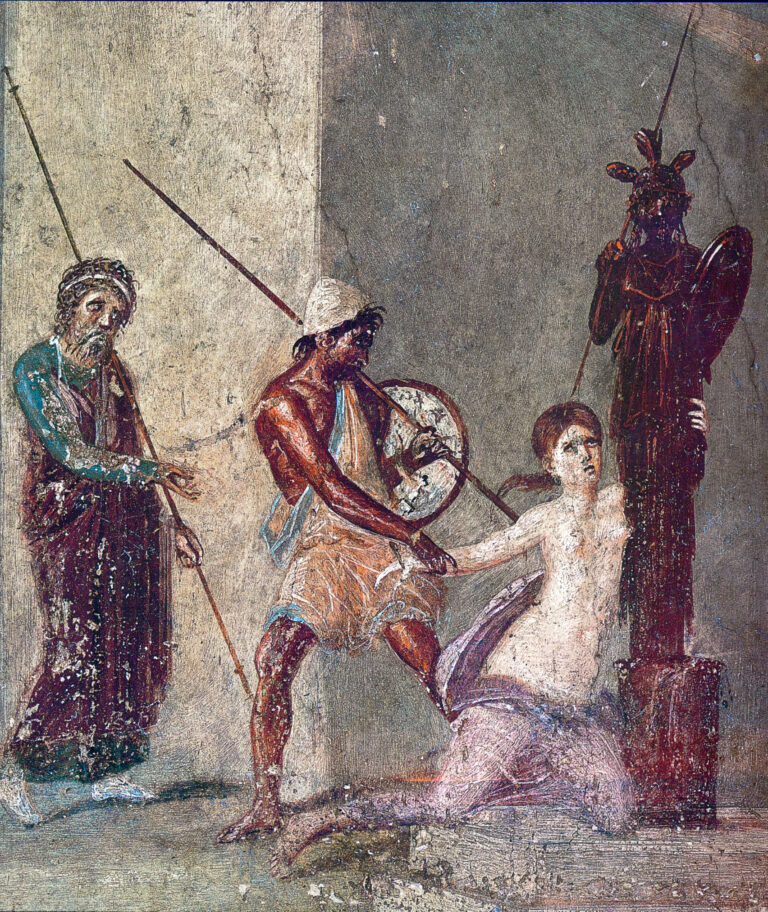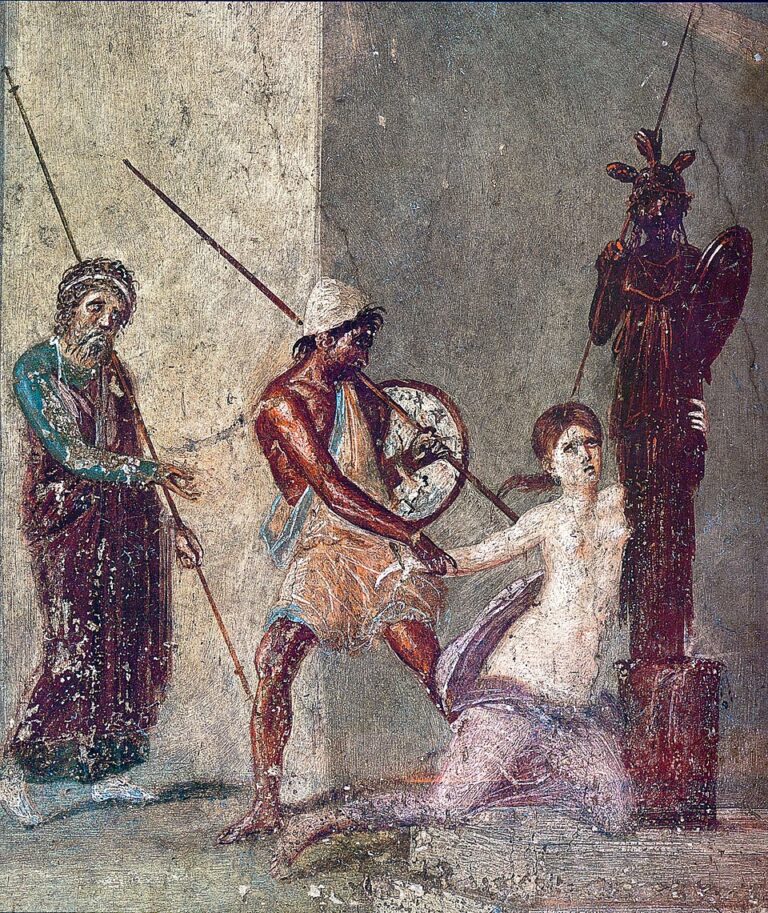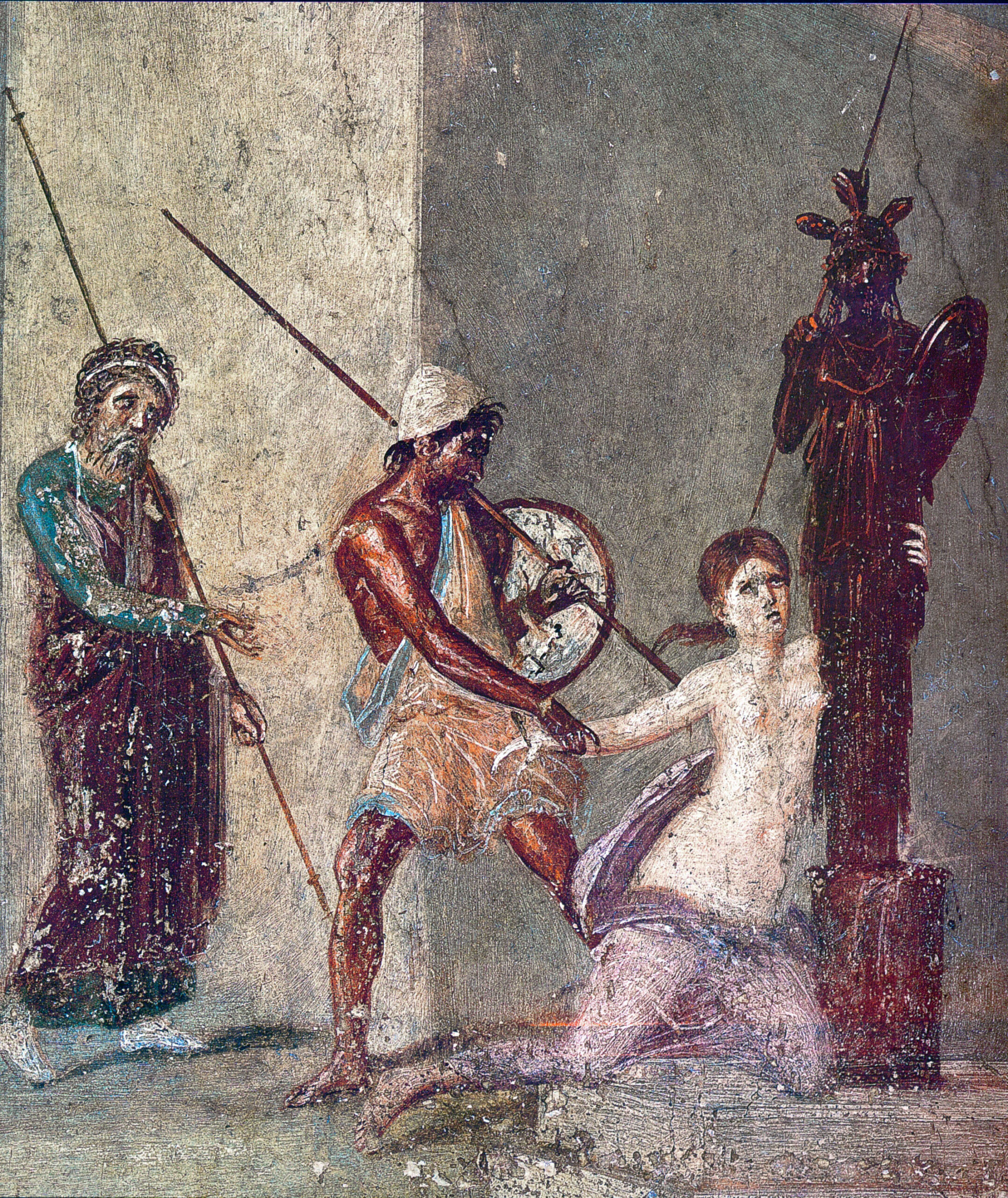
Why is Cassandra dancing?
“My mad daughter Cassandra is coming here on the run”1 – with these words, Hecuba announces Cassandra’s entrance in The Trojan Women. Much can be said and written about this striking scene. To approach it from a psychoanalytic perspective, the first question we must ask is: What makes this appearance so extraordinary?
A Tragedy without Action
Before I am able to discuss the particularity of her appearance, a pivotal feature of the tragedy must be mentioned. The Trojan Women deals with the four women Hecuba, Cassandra, Andromache, and Helen all of whom are captured and awaiting their fate. But the drama lacks any real plot or action. Rather, the play consists of a succession of scenes occurring almost in real time, linked only by the figures of Hecuba and Talthybius. The focus on a singular site—the camp in front of the destroyed walls of Troy—also creates the impression that this tragedy is very much temporally and spatially condensed. While reading it for the first time, I was instantly reminded of the Sidney Lumet movie Dog Day Afternoon. In this classic, Al Pacino and John Cazale rob a bank. Lumet stages the twelve-hour-long bank heist in such a condensed way, making the audience feel present every single minute. I observe a similar notion in The Trojan Women. Nonetheless, there is a premise that governs the unfolding action of the tragedy. Athena and Poseidon converse in the prologue and agree on punishing the Greeks for their offenses. The play ends with the departure of the Greeks without the deus ex machina that is typical for Euripidean tragedies. No gods appear after the prologue. Within this construction, Cassandra’s appearance occupies a unique position.
Frenzy Instead of Grief
Cassandra’s behavior differs fundamentally from Hecuba’s, Andromache’s and Helen’s. She ardently voices her feelings and does not appear to be paralyzed, apathetic and mourning like the rest of the vanquished. Her loss of reality is especially striking. Her words appear to be out of place. Cassandra plays a pivotal role in the unfolding of the tragedy. It was the rape of Cassandra by Ajax that Athena cites, among other reasons, as grounds for punishing the Greeks (69-70). This punishment of the Greeks constitutes the premise of this tragedy, even though it lies beyond the boundaries of the play. This apparent contrast between her joy and ecstasy and the actual situation she is in points toward an “altered mental status.”
The Vocabulary
Hecuba, Talthybius and the chorus provide the first clue to the connection between psychoanalysis and Cassandra’s appearance. They all use a vocabulary that is associated with an altered mental status. Hecuba, in line 307, uses the term μαινάς. Kovacs translates this as “mad” while Coleridge 2 uses the term “frenzied.” The same term is used by Talthybius in line 415: “[…] has succumbed to a passion / for this madwoman […]” (Kovacs) and “[…] has yielded to a passion / for this mad maiden of all others.” (Coleridge). Furthermore, the chorus uses the term βακχεύουσαν in line 341 (“delirious”/”frantic”) and Talthybius uses it in line 408: “If Apollo had not struck your wits awry […]” and “Had not Apollo turned your wits to maenad revelry […].” The characters surrounding Cassandra call her mad and dismiss her words as delusional ravings. What they fail to recognize is that her prophecy of the Greeks’ destruction on their way home will indeed come true. From the text itself, it becomes apparent that Cassandra is experiencing some kind of episode. Admittedly, this fact already warrants a psychoanalytic interpretation. However, I would like to highlight two features of her appearance that are highly relevant to the psychoanalytic reading of The Trojan Women.
Bridging Time
The first characteristic concerns Cassandra’s position in relation to the dimension of time. Cassandra is the only character who is able to connect the beginning and the end of the tragedy. Thalia Papadopoulou describes the function of time within the tragedy:
“This scene introduces the three prevailing time levels: the present, which constitutes a series of images of defeat and grief, the glorious Trojan past (45) and the future, which will reverse the conditions by destroying the Greeks (65-66, 75, 80-81, 87)”3.
Thus, the characters adopt different attitudes towards these levels. Hecuba, for example, tries to withdraw from the present by escaping into the past, which is a psychological mechanism that will be examined at a later point. The Greeks associate the future not with hopelessness but with confidence. Yet, not a single character, but for one, recognizes the divine plan that was already set in motion in the prologue. This character is Cassandra.
“The only person to cause a breach in this ignorance is Cassandra, who, relying on her foreknowledge, adopts a totally different attitude to time, thus constituting a contrasting figure in the play.”4.
What is unique about Cassandra is her attitude to time. Because she not only knows the divine plan but also predicts it, she is able to await the future, in contrast to the others, filled with optimism and felicity. She looks forward to her marriage to Agamemnon because she knows this will seal the demise of the Greeks. She dances euphorically not because she is a madwoman but because she knows exactly what will happen hors-de-scène. It is, of course, inherent to her mythological conception that her prophecies are never believed. It comes as no surprise that both Hecuba and Talthybius call her mad. Linked to the prologue, Cassandra transcends both the temporal and spatial dimensions. She bridges the present and the future, as well as the divine and human spheres.
“At the end of the play, Euripides will need no deus ex machina. The combination of these two scenes is so powerful and effective that the echo of their implacable truth threateningly hangs over the departure-scene at the end.”5
Ecstasy and Rationality
The second feature concerns the structure of her appearance. Her appearance can be divided into an ecstatic (308-40) and a rational-argumentative (353-461) section. After storming out of the tent, torch in hand, she strikes up a wedding hymn directed at Hymenaios. This song, like the entire appearance of Cassandra, is filled with ambiguity and contradictions. In the form of a wedding hymn, Cassandra sings—in an almost parodic and ironic manner—of the downfall of her future husband.
“Cassandra’s hymn to Hymenaios is an ironic parody of the songs of this kind, in which ritual is totally distorted. It is a marriage song to Hymenaios, but through multiple connotations it turns into an exhilirated and fervent hymn to Death and the power of certain revenge.”6
Cassandra inextricably connects, through her song, death and marriage. But this ambiguity goes even further than the discrepancy between form and content. The macarisms are particularly striking, as they are traditionally employed in both wedding songs and for those marked for death. I would like to again point to the cited essay by Papdopoulou, in which she analyzes this ambiguity in a thorough and detailed manner. Let us put on record the following: There is a fundamental ambiguity present within Cassandra’s wedding hymn. On the one hand stands marriage (and thus procreation), while on the other stands death.
If the wedding song exhibits such ambiguity, then tragic irony inevitably follows. In the argumentative part of her appearance, Cassandra tries with great effort to invert the roles of vanquisher and vanquished. Hinted at in the wedding song and explicitly stated in the argumentative section, it becomes clear that she considers Troy’s glory to be everlasting. The war’s true victors are the Trojans who sacrificed themselves heroically on home soil. What she disavows is her immediate reality: Troy is ablaze and she is about to sail towards her certain death. Her optimism is by no means a figment of her imagination, but rather a product of her foreknowledge. This is where her profound psychological conception is revealed. She is able to grasp the future due to her foreknowledge and thus looks ahead fearlessly. However, she refuses to acknowledge the present, which constantly pierces her optimism:
“Even her revenge on the Atridae, which seems to be her only reason to live, will not resuscitate Troy. Cassandra knows this fact but refuses to admit it.”7
Hecuba meanwhile is able to grasp the present—even if she tries to escape it with all her might—but is blind to the future. The decisive difference is that Hecuba cannot know the future, whereas Cassandra does not want to know the present. It becomes evident that a psychological mechanism appears to be at work here.
The Uniqueness of Her Appearance
In summary, the following features characterize Cassandra’s appearance: Her immediate surroundings point to an altered mental status, she is able to bridge temporal dimensions, her language is filled with ambiguity and she misjudges her current situation. Based on these features, I would like to launch my first series on this blog and examine whether Cassandra exhibits hysterical mechanisms. The bridging of temporal dimensions, in particular, is a core element of Sigmund Freud’s observations regarding hysteria. Thus, it constitutes a juncture between tragedy and psychoanalysis.
The comparison between Euripides and Lumet’s condensation of time may seem daring at first. But can the dynamics of an ancient tragedy still be grasped today without a modern frame of reference? I invite you to share your thoughts on this kind of contextualization.
Cassandra: A Case of Hysteria?
This series, consisting of six parts, constitutes my attempt to connect Cassandra’s appearance in The Trojan Women with Sigmund Freud’s concept of hysteria. The goal will not be to definitively diagnose Cassandra as “hysterical” and to prove this. Rather, my aim is to identify hysterical elements within her performance. Freud’s observations on hysteria find several correspondences within the tragedy, which I shall explore in the following.
Before doing so, however, a few disclaimers are in order. This series refers to Sigmund Freud’s & Josef Breuer’s observations in the texts Studies on Hysteria and The Aetiology of Hysteria. I am well aware that Freud later moved away from the seduction theory proposed in these texts, in favor of developing and pursuing the theory of infantile sexuality. It should also be mentioned at this point, that the (supposed) reasons for this change of paradigm are heavily criticized in some circles. I will address these reasons—some of which have found their way into relevant social media circles—in a separate post, where I will subject them to a historical stress test. Back to Cassandra: Both of these texts about hysteria appeal to me very much, because they are remarkably clear and empirically derived. While some of Freud’s later texts or concepts may seem abstract and not immediately tangible, his early concept of hysteria is empirically grounded.
The structure of this series is guided by the different components of hysteria that I deduced from the texts. Naturally, hysteria cannot be broken down into isolated components, as none of its characteristics stand alone. It is clear that this illness—like any other—consists of a combination of symptoms and aetiology. Nevertheless, for my purposes, several core aspects shall serve as a guide. I will dedicate a separate post to each of these core aspects:
- The underlying psychic trauma of hysteria and its reproduction
- The strangulated affect
- Somatic symptoms
- The field of sexual experience
It is particularly these four characteristics that are reflected in Cassandra’s appearance—and beyond—making it so compelling. The fifth post will focus on the conclusions drawn from the results of this analysis.
Sign up here to receive the latest essays on Euripides, psychology, and history directly in your inbox:
- Euripides, Trojan Women, edited and translated by David Kovacs, Loeb Classical Library 10, Cambridge, MA: Harvard University Press, 1999.
- Euripides. The Plays of Euripides, translated by E. P. Coleridge. Volume I. London. George Bell and Sons. 1891.
- Papadopoulou, Thalia. “Cassandra’s Radiant Vigour and the Ironic Optimism of Euripides’ ‘Troades.’” Mnemosyne, vol. 53, no. 5, 2000, pp. 513–27, at 513–14.
- Papadopoulou, “Radiant Vigour,” 515.
- Papadopoulou, “Radiant Vigour,” 515.
- Papadopoulou, “Radiant Vigour,” 520.
- Papadopoulou, “Radiant Vigour”, 526.