Cassandra: A Case Study of Hysteria? (1/5) – Trauma
In the introductory post, I highlighted the distinct characteristics of Cassandra’s appearance in The Trojan Women. Now, I will examine whether this appearance reflects the mechanisms of Freudian hysteria. The first step: the traumatic experience.
Basic Research
From a modern perspective, I am deeply indebted to Freud, as he provided a definition of trauma relatively early in his Studies on Hysteria. At a time when almost everything is called “traumatic”, it is quite hard to keep track. If I were to follow only modern classifications of clinical disorders—the merits and demerits of which could be debated endlessly—I would have to look for specific events in Cassandra’s life: war, (sexual) violence and other life-threatening dangers. Interestingly (and for every psychologist probably painfully obvious), there is no direct definition of “trauma” in modern diagnostic classifications. “Trauma” only appears in definitions of clinical pictures that are connected to it. From a layman’s perspective, trauma only appears connected to pathology. A look into the DSM-5 reveals no actual definition; instead, it merely categorizes trauma-related disorders. No event is inherently traumatic. To sidestep these exhaustive debates, however, I would like to explain my approach to this question.
I have isolated three constituents of hysteria from the Studies on Hysteria. Hysteria consists of symptoms in the present, a precipitating event in the past and a connection between the two. According to Freud, the hysteric suffers from symptoms that have their cause in a past psychic trauma. Symptoms and cause are directly or symbolically intertwined. I would like to direct our attention to this connection because it helps our search for Cassandra’s trauma. If we were to remove the psychoanalytical vocabulary from this connection, a connection between past and present is all that remains. A past event reverberates into the present. From this, it follows that our search for Cassandra’s trauma does not start in the past (the trauma) but rather in the present (the symptom). In true psychoanalytic fashion, we must first lend an ear to Cassandra’s words in The Trojan Women before investigating whether there is a connection to her past.
What say you, Cassandra?
I already analyzed her few spoken lines closely in the preceding post. Cassandra sings a wedding hymn that is characterized by one feature in particular: ambiguity. She takes the vessel of a wedding hymn and fills it with content about death. Thus, she perverts the original connotation. A song about marriage —and by extension procreation—is conflated with death. This connection shall be noted for a later time. Let us take a look at her choice of words. Cassandra utters phrases like:
- Escort me on my way, and if in your eyes I do not seem / eager, push me along by force! (355-56)
- […] and at that a / woman who was abducted of her own free will, not forcibly. (372-73)
- […] when I am / cast out as a naked corpse […]. (448)
- […] Depart from my flesh as / I tear you away, so that while I am still pure in body I may give you / to the swift winds to carry to you, my prophetic lord! (453-54)1
These utterances come from different sections of her appearance, and I deliberately removed them from their context. They illustrate the following: Cassandra constantly employs a vocabulary associated with violent displacement. We would use the same verbs—push, abduct, cast out, tear—to describe a situation in which someone is subjected to coercion. I would also like to point out the sexual connotations of “naked” and “pure in body.” Thus far, focusing on her precise choice of words may seem enigmatic, but I entreat the reader’s patience; its significance will become clear in due course.
The substance of her speech is also of crucial importance when examining the question of Cassandra’s trauma. With her fiery speech, Cassandra desires only one thing: she wants to convince her mother of the fact that the Trojans are not the vanquished but actually the victors. She supports this argument by prophesying the fate of the Greeks—namely, the Odyssey—and by referencing the battle for Troy. She argues that the Trojans are the true victors of war, because they died on home soil and sacrificed themselves heroically, while the Greeks will be buried a long way from home. Crucially, she references the fight for Troy to prove that the Trojans met with a better fortune than the Greeks. Additionally, she is wielding a torch as she emerges out of the tent. This torch carries with it a symbolism that can be connected to Cassandra’s trauma.2
These aspects form the inventory of present “symptoms” that I interpret in her appearance. Now it is time for the next step: connecting these symptoms to a traumatic event in Cassandra’s past.
What is at Play?
Sigmund Freud defines the precipitating trauma rather loosely:
Any experience which calls up distressing affects —such as those of fright, anxiety, shame or physical pain—may operate as a trauma of this kind; and whether it in fact does so depends naturally enough on the susceptibility of the person affected (as well as on another condition which will be mentioned later).3
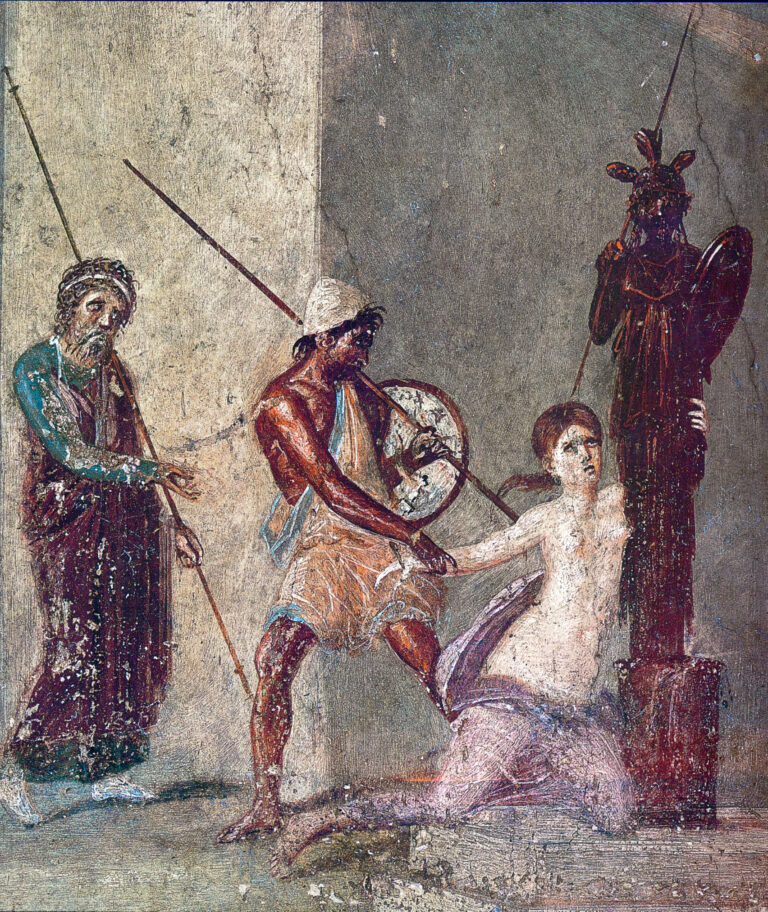
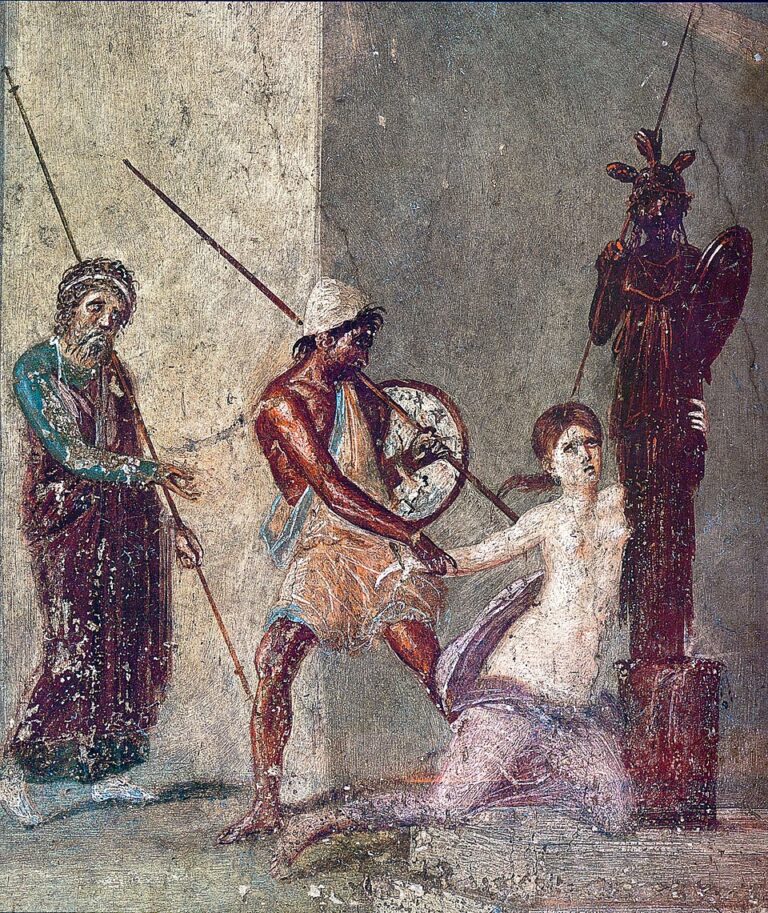
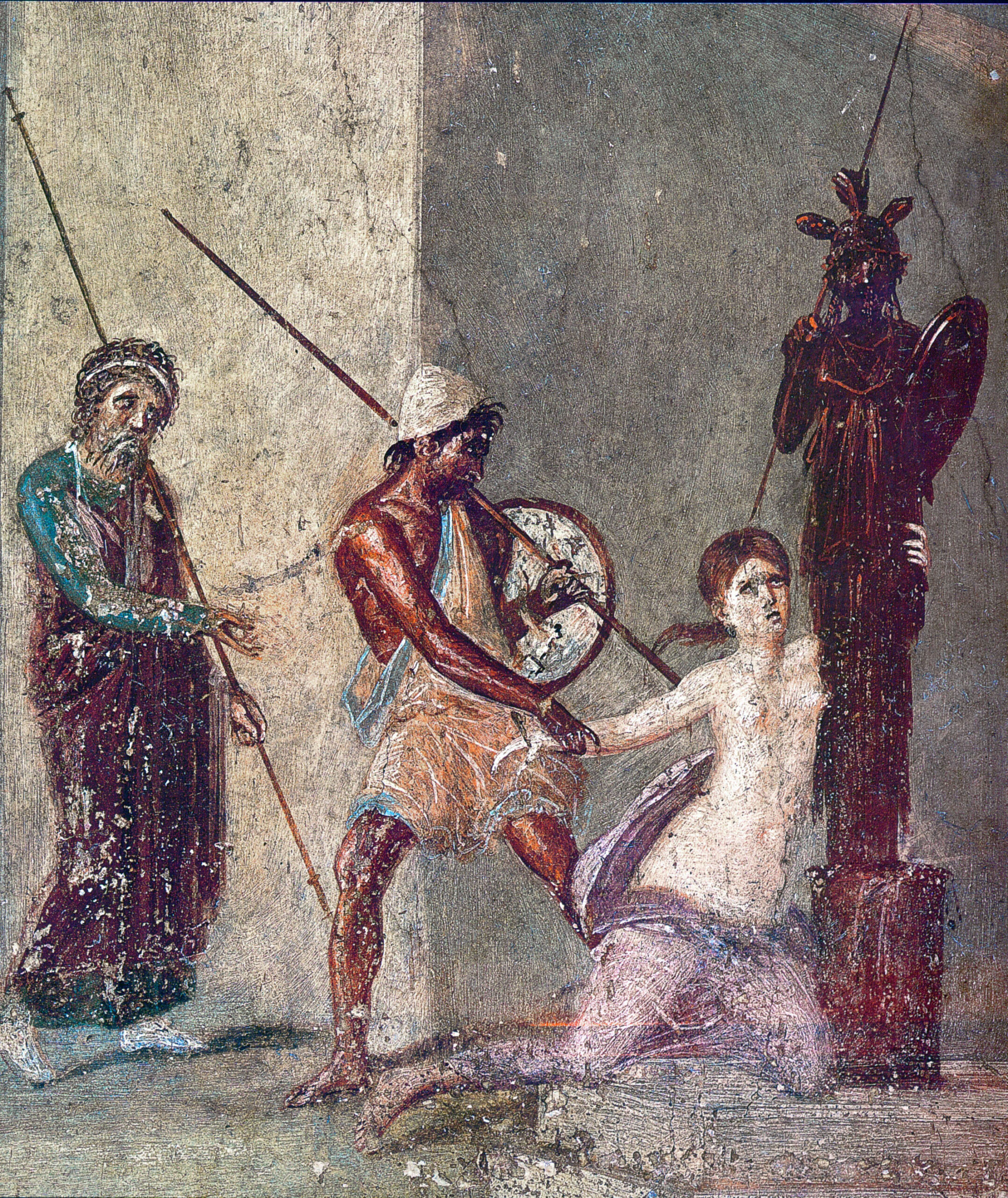
In my opinion, two incidents warrant investigation; not because they are inherently traumatic, but because they are clearly reflected in Cassandra’s present appearance. I am referring to the rape in Athena’s temple and the battle for Troy. For the purpose of this analysis, these events shall be viewed separately. In reality, they are interconnected, as the rape took place during the battle for Troy. Cassandra’s rape, in particular, serves as a linchpin in The Trojan Women, because Athena refers to it to justify punishing the Greeks. Before I pursue the question of whether these events can be connected to the present, I would like to pose a different question: What does ancient literature tell us about these events? Does Cassandra demonstrate in other texts whether the trauma comes to light?
What does Ancient Literature Say?
Some of the most famous texts of antiquity deal with the battle for Troy and Cassandra’s role during and after the conflict. Yet only a handful of texts actually describes the events that took place in the temple. Chronologically speaking, the earliest reference can be found in the Iliupersis. This epic belongs to the so-called Epic Cycle and is accessible to us—except for a single fragment consisting of eight hexameters—only through summaries in the Chrestomathy of Proclus and the Bibliotheca of Apollodorus. As the name implies, this epic deals with the sack of Troy. However, anyone expecting a dramatic account of the events will be disappointed. Since it is a summary, only a single sentence remains to describe the events in the temple:
Ajax, the son of Ileus, in dragging Cassandra away by force, pulls Athena’s wooden statue along with her.4
A similar picture emerges out of the Bibliotheca of Apollodorus. This comes as no surprise since he refers to the same source:
And the Locrian Ajax, seeing Cassandra clinging to the wooden image of Athena, violated her; therefore they say that the image looks to heaven.5
A third reference to this event can be found in the Posthomerica of Quintus Smyrnaeus. This poet lived in the fourth century AD, and his work also deals with the Trojan Cycle, providing a more extensive account of the scene.
[…] Not that even wise / Tritogenia herself was entirely without tears, when the mighty / son of Oïleus raped Cassandra inside her temple, his heart and / mind impaired by madness. She would later inflict on him terrible / misfortune as punishment for his shameful crime. As it was, she / did not actually see the disgraceful deed: in a sudden access of / modesty and anger she turned her grim gaze toward the high roof / of the temple as her sacred statue made a loud noise and the floor / of her temple shook. But even then he did not desist from his / foolish crime, because Cypris had impaired his mind. (420-429)6
This account is indeed more extensive and at least provides some clues as to how Cassandra felt in that moment. However, even this account is not sufficient to answer the question of whether this experience manifests as a trauma in her case. Yes, we can imagine the traumatic nature of the rape, but these texts do not give Cassandra a voice. Only Euripides (amongst others) does this.
Cassandra’s Mind
To my mind, Cassandra’s words in The Trojan Women mirror the—previously unspoken—emotions she experienced in the temple of Athena. There exists a parallelism. In her marriage hymn, Cassandra conflates the act of sexual union with death and thus perverts the actual meaning of sexual union. Does the same process not also take place during the rape? In that case too, the meaning of sexual union is perverted and detached from the true purpose. The aim of this act is not procreation or marriage but something else. It is not surprising that, after the rape, Cassandra associates the sexual act with death, and it is not far-fetched that Cassandra reproduces this association later on in the tragedy. In my view, this association constitutes the connection between past and present. In singing of death through the guise of a wedding hymn, Cassandra invokes the events in the temple of Athena, where the exact same intertwining of marriage and death took place. From a superficial perspective, her utterances are the words of a madwoman. I firmly believe that Euripides chose these words consciously because he understood the mythological conception of Cassandra. I will elaborate on this belief in a separate post.
If we were to qualify the rape as a precipitating trauma, her choice of words also makes sense. Her vocabulary mirrors the rape just as the marriage song does. This occurs not in an abstract or symbolic way, but on a literal level. She again connects sexually charged words (“naked” and “pure”) with a distinct category of verbs (“push”, “tear,” and “abduct”). These words conjure up the image of a violent experience. The content of her speech is riddled with words that signify physical violation.
She refers to the battle for Troy, which also might come into play as the precipitating trauma. There is no significant act of interpretation needed. The Trojans are the true victors of the war because they fell in defense of their homeland against the Greeks, who will be annihilated later on regardless. It might sound trite, but Cassandra connects the past event, the battle for Troy, that is, by simply reciting it in the present. She could have used different arguments to “prove” that the Trojans are the true victors. Nor should we disregard the torch she is wielding because it also represents the battle for Troy which is connected to the present through her words.
What Remains?
At the end of this post, I would like to direct our attention to a central feature of any kind of psychoanalytic interpretation. Sigmund Freud begins his search for the precipitating trauma always at an actual symptom. Through a chain of associations, he reaches an event that is responsible for the hysteria. I may have used a similar approach but I would like to firmly note that my starting point is already derived from an act of interpretation. Unlike a symptom encountered by a psychoanalyst in a clinical setting, Cassandra’s symptoms are a result of my own interpretive reading of the tragedy. We encounter this “problem” time and again when applying psychoanalytic interpretation to ancient tragedies, because we are dealing with texts that demand close reading and do not provide absolute truths. Nevertheless, I am convinced that the connection I have outlined between Cassandra’s past experiences and her present situation within the tragedy is well-founded.
Where does this leave us? There are two events that can be interpreted as a trauma in a Freudian sense, namely the rape in Athena’s temple and the Battle for Troy. Not because they are inherently traumatic or belong to a modern clinical category, but because they actively shape Cassandra’s behaviour in the present. Now we can turn to a second feature of hysteria: the strangulated affect.
Freud does not define trauma primarily by the event itself, but rather by its delayed effect in the present. How do you evaluate this approach in comparison to our contemporary, often clinically driven understanding of trauma-related disorders? Let us discuss the timeless relevance of these early psychoanalytic concepts.
Cassandra: A Case Study of Hysteria?
This post is part of my six-part series on Cassandra’s appearance in Euripides’ The Trojan Women:
- Part 0 (Primer): Why is Cassandra dancing?
- Part 1: Cassandra’s Trauma [You are here]
- Part 2: The Strangulated Affect
- Part 3: The Physical Symptoms
- Part 4: The Field of Sexual Experience
- Part 5: Conclusion
Sign up here to receive the latest essays on Euripides, psychology, and history directly in your inbox:
- Unless otherwise specified, all citations refer to the Loeb edition of Euripides’ Trojan Women (ed. and transl. David Kovacs, Harvard University Press, 1999)
- more on this in part four of this series.
- Sigmund Freud and Josef Breuer, Studies on Hysteria, trans. James Strachey (London: Hogarth Press, 1955), 6.
- Martin L. West, ed. and trans., Greek Epic Fragments: From the Seventh to the Fifth Centuries BC, Loeb Classical Library 497 (Cambridge, MA: Harvard University Press, 2003), 147.
- Apollodorus, The Library, trans. James George Frazer, Loeb Classical Library 122 (Cambridge, MA: Harvard University Press, 1921), Epitome V, 22.
- Quintus Smyrnaeus, The Fall of Troy, trans. Neil Hopkinson, Loeb Classical Library 19 (Cambridge, MA: Harvard University Press, 2018), XII, 420-29).