Cassandra: A Case Study of Hysteria? (4/5) – The Field of Sexual Experience
Trauma, Affect, Body—these are the concepts we have examined so far. Our journey—and this series—will conclude where it all began; with the myth of Cassandra. Yet, we will not examine the traumatic violation within Athena’s temple; instead, we will look at the myth of the unheeded prophetess itself. This requires a deep dive into her childhood and her adolescence before Troy’s fall. Who exactly is Cassandra? And what might Freud have to tell us about her?
A pivotal passage in Freud’s writing inspired me to dedicate a post to this issue. In The Aetiology of Hysteria, Freud writes about a concept he calls the “field of sexual experience”—the ultimate destination where all long chains of association inevitably lead back to. In this post, we will examine this passage closely before asking ourselves whether the myth of Cassandra is situated within this very field. To answer this question, we must venture deep into the myth and trace its origins back through ancient sources. This post serves as a foundational stepping stone for an upcoming Typos post, in which I will investigate the extent to which Euripides adapts the myth of Cassandra.1
The Field of Sexual Experience
Whatever case and whatever symptom we take as our point of departure, in the end we infallibly come to the field of sexual experience. So here for the first time we seem to have discovered an aetiological precondition for hysterical symptoms.2
This is how Freud initiates a chain of thought that is of pivotal importance to his understanding of hysteria. At the end of this chain, Freud reports a striking finding: the underlying cause of each of the eighteen cases he had treated so far was a sexual experience during childhood. This so-called seduction theory will become vital as history unfolds, since Freud would later distance himself from it. Today, a persistent narrative circulates suggesting that he did so to protect the perpetrators.3 For now, this shall not concern us. Let us examine Freud’s thesis; the assessment of its adequacy I leave to you.
Freud states that sexual experiences during adolescence—which encompass a broad spectrum ranging from severe sexual abuse to merely overhearing an obscene joke—are not deterministic enough to cause hysteria. While these experiences are frequently present, they do not withstand psychoanalytic scrutiny as primary causes. Thus, Freud suggests tracing the determination of the symptoms back to experiences that occurred even further in the past—namely, during early childhood, a “period before the development of sexual life.”4 In doing so, Freud articulates a deeply disconcerting conclusion: the ultimate determination of hysterical symptoms lies in “sexual experiences affecting the subject’s own body—[…] sexual intercourse (in the wider sense).”5
I therefore put forward the thesis that at the bottom of every case of hysteria there are one or more occurrences of premature sexual experience, occurrrences which belong to the earliest years of childhood but which can be reproduced through the work of psycho-analysis in spite of intervening decades.6
Freud describes a concept that still resonates in the twenty-first century, albeit no longer filed under the term “hysteria”: the fact that sexual trauma during childhood may lead to trauma-related disorders in adulthood. Later on, Freud categorizes these early childhood sexual experiences into three distinct types: instances of abuse by adult strangers, the initiation into sexual intercourse by a caretaker looking after the child, and sexual relations between children. What we are dealing with are premature sexual experiences that Freud identifies as the primary cause of hysterical symptoms. Thus, we have discovered a further mechanism of hysteria.
The Paradigmatic Female Adolescent
Let us now connect this mechanism to Cassandra and ask the following questions: Did Cassandra have a premature sexual experience? Does her childhood and adolescence unfold within the realm of sexual experience? What exactly about Cassandra is sexually connoted?
Before we dive into the ancient sources, let us turn our gaze to The New Pauly. In a sense, doing so anticipates the answer to our questions, as her entry is rather telling.
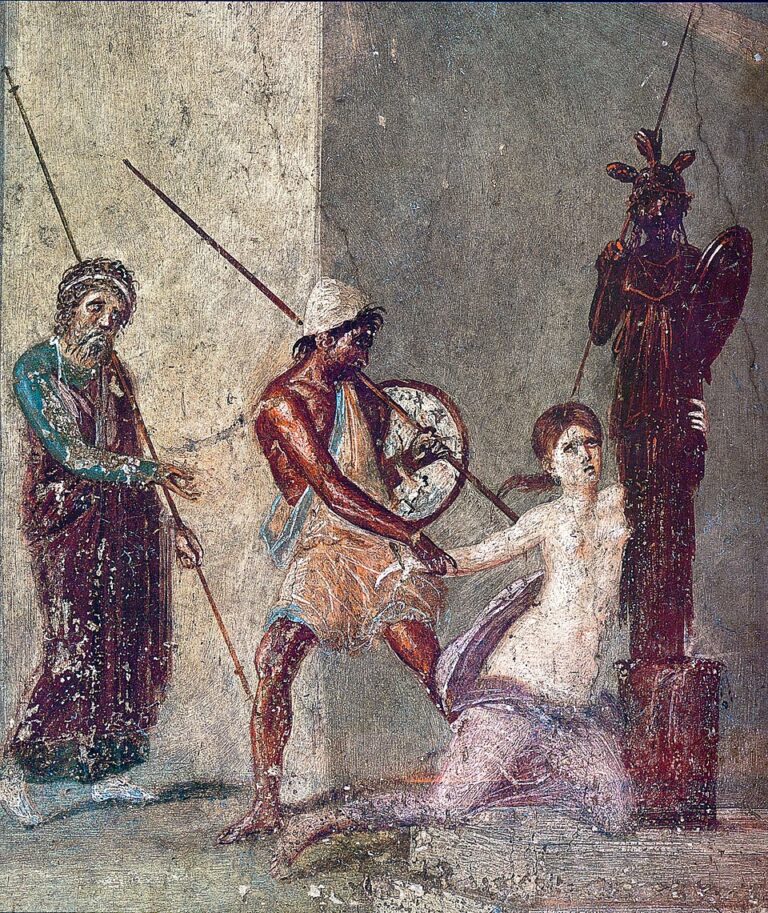
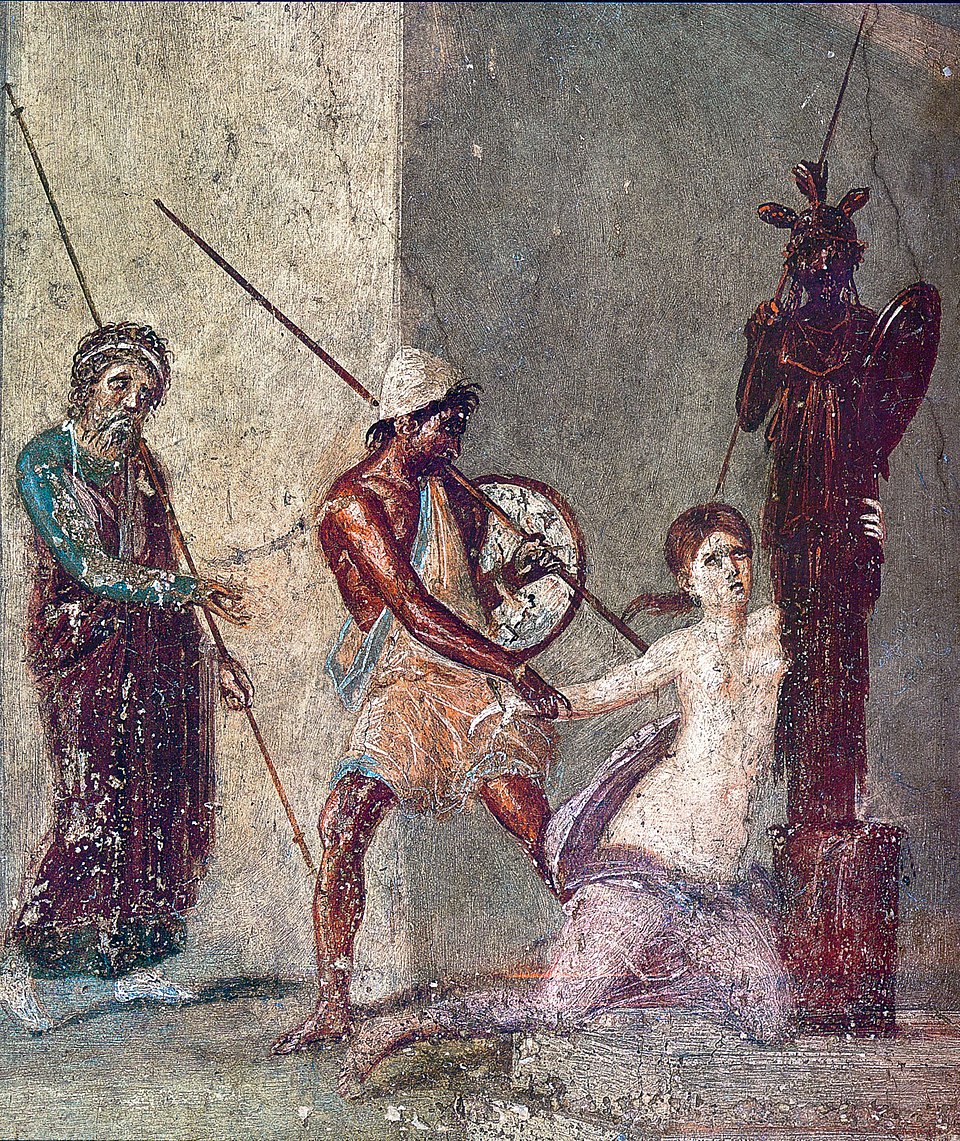
Κασσάνδρα, Kassándra, ‘who stands out among men’ […]. Beauty, youth and social status as a princess make her the paradigmatic feminine adolescent. The attempted rape on the part of Ajax [2]
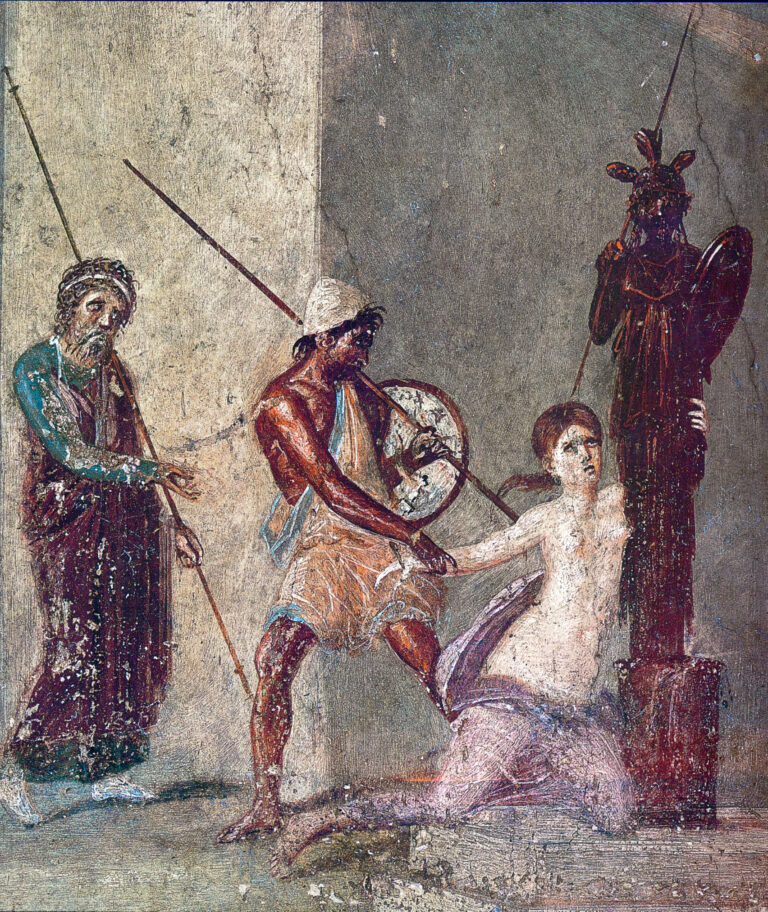
fits this scenario; afterwards C. sought asylum at a statue of Athena in her sanctuary, as is reported already in the Iliupersis and in Alcaeus (S 262 Page) and is also alluded to in the earliest pictorial representations in the 6th cent. BC by C.’s (partial) nudity and her youthful appearance [2. no. 48-55].7
To describe the myth of Cassandra as merely “sexually connoted” is, in a sense, an understatement. Cassandra is not a sexual connotation; she is the paradigm of (attempted) sexual violence. She does not merely touch upon this theme—she is constituted by it. That is her myth. To anticipate the answer to how her story unfolds, let us first turn our gaze to the specific aspects that connect Cassandra to sexual intercourse, before narrowing down our investigation.
Her Name, Her Words, Her Actions
First and foremost, her very name must be mentioned. “Who stands out among men” implies that she is highly desirable offering a pseudo-explanation for her rape. The events in the temple have been discussed plenty in previous posts already. Now, we can add the nudity in visual representations to the list of aspects that connect Cassandra to sexual intercourse. To be sure, nudity is by no means a revolutionary concept; however, when coupled with these other factors, a distinct pattern begins to emerge. At first glance, much, if not all, of her myth is sexually connoted. In fact, Euripides extends this sexual dimension beyond her mythic past, projecting it directly into the tragedy and the immediate present.
The wedding hymn, whose meaning I have sought to deconstruct, possesses an inherent sexual connotation due to the fact that procreation is inextricably bound to the institution of marriage. Her marriage to Agamemnon constitutes a forced sexual union. If we view Cassandra as dancing a Bacchic dance, it becomes clear that her connection to Dionysos is likewise sexually connoted. If the Dionysian realm is fundamentally about the blurring of boundaries and the liberation of instinctual drives, then the sexual drive is, without a doubt, central to this process.
I would like to add to this a feature I have not mentioned yet, namely the meaning of the torch in the context of the tetralogy. In the fragmentary Alexandros—the first tragedy of the tetralogy which includes The Trojan Women—Hecuba, during her pregnancy with Paris, dreams of birthing a burning torch that will ruin Troy. In the context of the tetralogy, Euripides uses this as a form of foreshadowing, as Paris’s return to Troy will ultimately trigger its downfall. Euripides physically manifests this downfall in two ways: by letting Cassandra wave a torch while stepping out of the tent, and by showing us that, in the end, Troy is indeed ablaze. In my opinion, and because of the aforementioned dream, the torch is also sexually connoted. Naturally, this is not as pronounced as the other facets of her appearance or myth. After all, the dream does not depict sexual violence; nevertheless, the torch indirectly symbolizes the sexual intercourse from which offspring originates.
Her Gift and Curse: The Origin
In the previous part, I presented a rather formless list of aspects that can be, in the broadest sense, connected to sexual intercourse. Furthermore, the New Pauly entry serves as a suitable starting point. Our search, however, continues. This post provides the necessary space to investigate the question of whether Cassandra has lived through something that Freud would consider to be a “premature sexual experience.” Those of you who are already familiar with the myth of Cassandra might remember that it is somehow tied to Apollo, and that she is a prophetess who is never believed. In German, there is the term Kassandrarufe (literally: “Cassandra cries”) which we use to refer to warnings that go unheeded. But what do the ancient sources tell us?
We find two diametrically opposed tales that tell the story of how Cassandra acquired her gift and curse. Before we examine the familiar tale of Apollo’s curse, let us turn our gaze to the lesser-known story. I have selected an ancient source for each story as an example to illustrate the respective narrative. Cassandra appears in numerous sources of a lyric, Roman, or mythographical nature. Besides her appearance in The Trojan Women, her most renowned appearance is in Aeschylus’s Agamemnon in which her curse is referenced.
Forgotten in the Temple
The lesser-known tale can only be found in the scholia on Homer. Quick note: Scholia are ancient marginal or interlinear notes written by scholars to explain and interpret literary works, such as Homer’s epics. In a way, they serve as the early ancestors of modern annotated editions. In a scholium on line 44 of the seventh book of the Iliad, we find the following:
ἡ ἱστορία παρὰ Ἀντιφάνει· φασὶ γὰρ τὸν Πρίαμον εὐωχούμενον ἐν τῷ τοῦ Θυμβραίου Ἀπόλλωνος ἱερῷ ἐπιλαθέσθαι τῶν παίδων Κασσάνδρας καὶ Ἑλένου· τοὺς δὲ ἐν τῷ ἱερῷ κοιμηθέντας ὑπὸ δρακόντων καθαρθῆναι τὰς αἰσθήσεις, καὶ οὕτως αὐτοὺς τὴν μαντικὴν λαβεῖν8
Since these scholia have not been translated into English, I will provide a brief summary. After celebrating a feast inside the temple of Thymbraean Apollo, Priam accidentally left behind his children, Cassandra and Helenus. While the children were sleeping in the sanctuary, serpents approached them and purified their senses. This is how they acquired their gift of prophecy.
In this tale, acquiring the gift is equated to biological change, and depicted as a wondrous event in Cassandra’s early life. Furthermore, this functions as a physical metaphor typical of classical mythology: a mental process (the acquisition of the gift of prophecy) is described through a bodily process (the purification of the ears). So far, so good. But does this story carry erotic or sexual connotations?
Of Serpents and Ears
It is not far-fetched to think that the penetration of bodily orifices by serpents constitutes a sexual metaphor; however, I will leave the mental imagery of this act to the reader. Then again, the serpents do not appear by coincidence. They embody—in a literal sense—Apollo. According to myth, he slew the Python in search of a spot for his sanctuary in Delphi—just to name one aspect that connects Apollo and serpents. It is common knowledge that gods appear to humans in the guise of animals. In turn, we are able to interpret this episode the following way: Apollo—by using serpents—gains bodily access to the sleeping children. This act can well be interpreted in a sexual way.
Speaking of sleep: let us bookmark the fact that Cassandra is sleeping in this episode; it will be important when we examine the other tale. I would also like to point to the relevance of this story. If we interpret the purification by the serpents as a form of initiation rite, it can be noted that bodily orifices are cleansed here so that Apollo can later penetrate Cassandra’s body. This story is about taking possession of a body. We cannot deny the fact that eroticism and sexual experience play a role here.
This coupling of insight and the body seems familiar to us from the Bible: “And Adam knew Eve his wife; and she conceived, and bare Cain….” In the Bible, the most intimate form of insight is always coupled with sexual union. This is precisely reflected in the Hebrew verb yada, which seamlessly connects these two dimensions. There exists no sharp distinction between the body (that has sex) and the mind (that gains insight). The same applies to the tale of Cassandra. Here, too, we find this profound fusion of insight and sexual union.
While the story of the serpents and Cassandra may not appear sexually connoted at first glance, a closer look reveals that it describes an act of physical union from which the gift of prophecy ultimately springs. If we picture this episode in our mind’s eye, sexuality resonates. Not only did we answer the question of sexual connotation, we too can note that this story deals with “sexual intercourse (in the wider sense).” While we are required to look closely at this tale to identify sexual connotation, the opposite is true for the more known tale. This story is about sexual intercourse.
Rejecting Apollo
Apollo’s curse on Cassandra is mentioned in multiple ancient sources. For this post, I have singled out the text of Hyginus. The exact identity of the author is quite unclear, but he is often connected to a contemporary of Augustus named Gaius Julius Hyginus. Hyginus wrote two mythographical books; in the Fabulae he writes:
Cassandra Priami et Hecubae filia, in fano Apollinis lusu lassa cum obdormivisset, Apollo eam comprimere voluit; cui Cassandra copiam sui non fecit. Ob quam rem Apollo fecit ut, cum vera vaticinaretur, fides ei non haberetur.
Cassandra, daughter of Priam and Hecuba, is said to have fallen asleep when she was tired of playing, in the temple of Apollo. When Apollo tried to embrace her, she did not permit him. So Apollo brought it about that she should not be believed, though she gave true prophecies.9
No major act of interpretation is necessary to state that this tale too is acted out on the field of sexual experience. Interestingly, we find here too the trope of the sleeping girl that Apollo tries to take in possession. Not only does this tale act out on the field of sexual experience, it also depicts an event that Freud mentions in the examples of premature sexual experiences. A person caring for the child attempts to make sexual advances toward them. This person, Apollo in this case, is closely tied to Priam and the city of Troy. This results in an egregious betrayal of his duty of care, to put it into modern terms. This tale clearly depicts a premature sexual experience at the hands of a supposed caregiver occurring in the same age group Freud mentions.10
It seems to be this very tale that Euripides reproduces in this tragedy. Psychoanalytically speaking, an ill-treated young woman enters the stage, re-enacting events from her past in the present. These events are intimately connected to sexuality, sexual abuse, and premature sexual experiences.
Conclusion
Let us now return to the core question of this post. Cassandra—her character, and her myth— is sexually connoted in almost every department. Let me specify this: We are able to identify a sexual ontology. Her whole existence, inside and outside the tragedy, is inseparably bound to sexual intercourse and desire. Without Apollo’s desire, there exists no prophetess Cassandra. This invites us, as individuals, to pose the philosophical question of the extent to which traumatic experiences determine our fate. I am certain that everyone holds a different answer to this.
At least one of the myths describes a premature sexual experience in childhood. The other myth depicts a similar event, albeit much more obscurely, wrapped in a physical metaphor. If we assume that Freud’s thesis maps an additional mechanism of hysteria—namely, that premature childhood sexual experiences contribute significantly to hysteria—we can establish that Cassandra embodies this mechanism as well. Having uncovered these mythological roots, we will weave all these threads together in the next and final part of this series to ground our findings in a concluding analysis
The ‘sexual ontology’ of Kassandra sketched here raises a fundamental question: to what extent does a (traumatic) fate determine our identity? Is an existence beyond this conditioning even envisioned within the myth? I look forward to your answers and philosophical insights.
Cassandra: A Case Study of Hysteria?
This post is part of my six-part series on Cassandra’s appearance in Euripides’ The Trojan Women:
- Part 0 (Primer): Why is Cassandra dancing?
- Part 1: Cassandra’s Trauma
- Part 2: The Strangulated Affect
- Part 3: The Physical Symptoms
- Part 4: The Field of Sexual Experience [You are here]
- Part 5: Conclusion
- For an explanation of the four post categories, please refer to the “About” page.
- Sigmund Freud, The Aetiology of Hysteria, trans. by James Strachey, vol. 3 (London: Hogarth Press, 1962), 187–221, at 199.
- I touched on this in the primer post; a dedicated post to this issue will follow.
- Freud, The Aetiology of Hysteria, vol. 3, 202.
- Freud, The Aetiology of Hysteria, vol. 3, 203.
- Freud, The Aetiology of Hysteria, vol. 3, 203.
- Bremmer, Jan N. (Groningen). “Cassandra”. In Brill’s New Pauly Online, (Brill, 2006) doi: https://doi.org/10.1163/1574-9347_bnp_e610080
- Erbse, Hartmut, ed. Scholia Graeca in Homeri Iliadem (scholia vetustiora). Vol. 2, Scholia ad libros Γ–Δ continens. Berlin: De Gruyter, 1971.
- Hyginus, The Myths of Hyginus, trans. Mary Grant (Lawrence: University of Kansas Press, 1960), Fab. 93.
- Cassandra is portrayed as a pre-adolescent child, possessing a capacity for resistance while still being in a stage of play.