Cassandra: A Case Study of Hysteria? (3/5) – The Body
Cassandra appears—dancing, singing, frantic. Her body does no longer seem to belong to her; she moves like a possessed being. In his Studies, Freud describes how a strangulated affect takes possession of the body, converting psychic pain into somatic pain. But do these symptoms truly exist in the Trojan Women? Furthermore, how do we deal with a tragedy (any tragedy?) whose physical manifestation on the stage is only accessible to us indirectly? To answer this, we must take a trip to the very boundaries of psychoanalytic interpretation.
On Thin Ice
If we turn to the question of Cassandra’s somatic symptoms, resistance immediately arises. In an age where psychological labels are tossed around so carelessly, caution is advised. Any attempt to diagnose Cassandra with definite physical symptoms is bound to fail from the get-go; she is not a patient presenting in a clinical setting. To attempt this nonetheless would reduce psychoanalytic interpretation to absurdity and remain mere speculation. Symptoms like paresis, neuralgia, or tics—to name a few—simply cannot be identified in her appearance. In fact, they seem entirely unwieldy in this context. We must seek a remedy through another path.
This path lies within the physical dimension of her appearance. Admittedly, there are only a few leads, yet they are quite fruitful in helping us reconstruct an image of her somatic presence. We will have to contend with this handful of leads because the text only hints at them implicitly. The first part of this post will characterize Cassandra’s appearance from a physical perspective, while the second part will discuss whether this characterization exhibits connections to hysteria. At this juncture, I would like to reiterate that a connection between the trauma and the symptom always exists. My question, thus, is this: does the physical dimension mirror something that can be found in the precipitating trauma?
On the Ambivalence of Stage Directions
Now, what does the text tell us about Cassandra’s body? Most—if not all—of it will look familiar. The first point of reference is found in the external form of her appearance. In most translations, a stage direction precedes her appearance. This stage direction does not originate from Euripides himself; rather it was added in the course of the editorial process. A look into different translations not only proves this but also paints a surprising picture.1
- Dietrich Ebener notes: “Kassandra (stürmt fackelschwingend aus dem Zelt)” which translates to: “Cassandra (bursts from the tent, brandishing a torch)”2
- Ernst Buschor completely forgoes any stage direction. However, he translates the final sentence (307) preceding Cassandra’s entrance to: “Mein Kind Kassandra stürmt mänadengleich heraus.” which translates to “My child Cassandra bursts out like a maenad.”3
- Gilbert Murray writes: [The door opens from within and Cassandra enters, white-robed and wreathed like a Priestess, a great torch in her hand. She is singing softly to herself and does not see the Herald or the scene before her.]4
- David Kovacs writes: Enter from the skene Cassandra carrying a flaming torch in either hand.5
Not only does this brilliantly demonstrate that translation is invariably interpretation, but it also paints two starkly different pictures here. While Buschor and Ebener focus on the fact that Cassandra “storms”/”bursts” (both are viable tranlsations of “stürmen”) of ouf the tent, Murray and Kovacs paint a different picture. Kovacs remains rather neutral, while Murray evokes an almost serene impression. Furthermore, an expression that signifies a hasty movement (in the sense of “storming out” or “running”) cannot be found in Murray’s translation of line 307: “’tis my child, Cassandra, […].” Thus, we are encouraged to interpret ourselves whether Cassandra rushes out of the tent or simply enters the stage. Then again, it is rather suspicious that Murray opts for this peaceful and serene interpretation. What now?
A logical next step would be to look at the original Greek text of Hecuba’s words just before Cassandra’s entrance, specifically line 307. Here, we find the verb θοάζει which, interestingly, allows for two entirely different interpretations. One translation is “move quickly”, “rush” or “dart” because it is derived from the adjective θοός (meaning quick or swift). However, the exact same verb appears in other classical texts denoting the act of “sitting.”
Thus, we have to acknowledge that the meaning of the Greek word itself is deeply ambiguous. This means that both readings—both “rushing in” and simply “entering”— are philologically justifiable, as the Greek original (intentionally?) leaves this ambiguity open. To return to the main focus of this post; there is an interpretative basis from which one can deduce that Cassandra enters the stage rapidly, beginning her appearance with significant momentum.
Implicit Stage Directions
As already mentioned, further clues remain rather limited, or are already known. Cassandra’s appearance is marked by movement and the discharging of energy. We know that Cassandra is dancing as she explicitly invites her mother to join her (332-33). The terms Hecuba and Talthybius use to describe Cassandra (see the primer post) are equally marked by this dynamism. They use terms ranging from frantic fury to a bacchic frenzy. Especially the connection to Bacchus illustrates that Cassandra is perfmorming a type of ecstatic dance. Put differently: If we were to visualize the onset of Cassandra’s appearance, we would hardly think of a tranquil scene in which the young woman calmly sings her song. While Murray points toward this serene picture from the very beginning, such a peaceful depiction feels deeply uncanny—if not outright contradictory—when looking at the scene as a whole. I personally interpret the beginning of her appearance as a violent outburst of compressed emotion that expends a massive amount of energy.
Strictly speaking, these clues are the most tangible ones. Additionally, I would like to point to the fact that Cassandra often directs our attention to her body (353, 362, 453). Furthermore, her mode of performance exhibits a fundamental difference from the other characters in terms of pace, volume, and appropriateness to the immediate situation. Cassandra suddenly takes up a lot of space speaking with almost no interruption. Within a tragedy composed primarily of dynamic dialogues, she breaks the structure by launching into an extended monologue. Lastly, there is a glaring disparity between Hecuba and Cassandra. While Hecuba—paralyzed by grief—is barely able to expend the energy needed to pick herself of the ground, Cassandra storms out of the tent bursting with energy, fervor, and driven by thoughts of revenge and a desperate drive to act.
If we add these clues up, we can note the following: every indicator points towards Cassandra being in a state of agitation (or restlessness). While she may not exhibit explicit somatic symptoms, her appearance possesses a distinc physical dynamism that sets her apart from the other characters. A glance into the existing literature on the tragedy confirms this notion.
Literature on Cassandra
Nearly every characterization of Cassandra in The Trojan Women that I came across fully emphasizes this agitation. A brief selection of these passages follows:
- This part (308-340) constitutes an ecstatic wedding song, delivered in a state of possession and trance, in which the bacchic elements prevail. Cassandra enters at a run, in a state of frenzy, waving torches, like a Fury […].6
- The enthusiastic tone of her celebrating hymn bursts out like a rapid stream determined to sweep all remaining despair.7
- At 443 Cassandra changes suddenly into trochaic tetrameter, with an increase in emotional intensity[…].8
- As her bacchic transe ebbs, Cassandra shifts to iambic trimeters.9
These passages from varying interpretations constitute only a handful of examples. One certainly notices that the adjectives used to describe Cassandra consistently confirm the impression that Cassandra is in a profound state of agitation. In particular, her metrical shift from ecstatic lyrical metres (such as trochees and dactyls) to the more regular iambic trimeter reveals that Cassandra expends significantly more energy during the initial part of her appearance. A glance at the existing literature shows that this image of agitation is frequently present when Cassandra is discussed. Now onto the connection to psychoanalysis.
Motor Phenomena
Sigmund Freud impressively describes the role of somatic symptoms pertaining to hysteria. I find especially fascinating the relation between the symptoms and the trauma that Freud often illustrates in his case studies. As already mentioned in the introduction of this post, the specific symptoms that Freud describes cannot be identified in the tragedy. Instead I would like to single out a quote and connect it to Cassandra’s state of agitation. Freud mentions so-called “motor phenomena” while discussing hysterical attacks:
The motor phenomena of hysterical attacks can be interpreted partly as universal forms of reactions appropriate to the affect accompanying the memory (such as kicking about and waving the arms and legs, which even young babies do), partly as a direct expression of these memories; but in part, like the hysterical stigmata found among the chronic symptoms, they cannot be explained in this way.10
If I understand correctly, Freud lists three interpretations of these motor phenomena.
- They function as a manifest reaction to the affect.
- They serve as a direct expression of the memories.
- Alternatively, they can partly defy both of these explanations.
I would like to direct our attention to the first interpretation. We have already established that Cassandra can be characterized as agitated or restless. This leads us to a second question: Is this agitation a manifest reaction to the affect?
First Clinging, Then Dancing
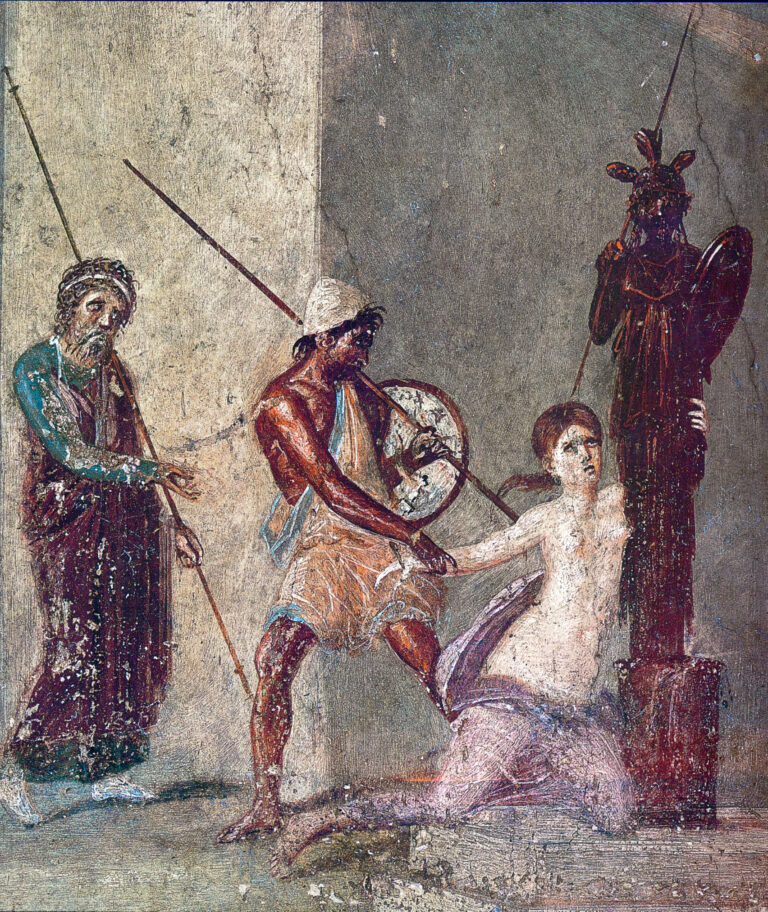
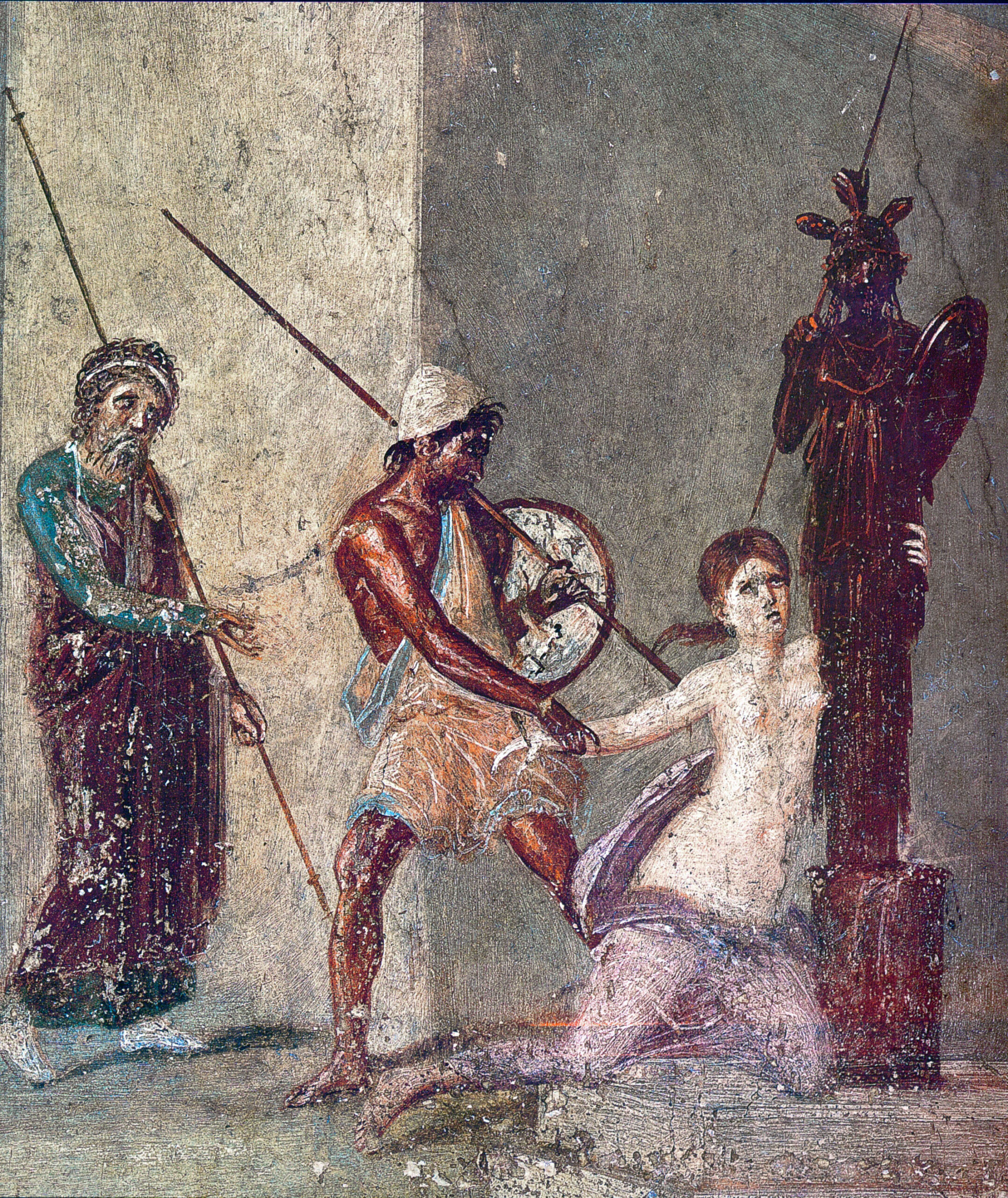
In the second part of this series, we already established that Cassandra personifies the previously suppressed response to the sacrilege. Even when we look at the connection between her agitation and the trauma (the rape) in an isolated way, we find a similar notion. In the precipitating traumatic situation, Cassandra was passive, clung to the statue of Athena, and was dragged away by Ajax. If we now consider her agitation in the tragedy, it can certainly be interpreted as a “manifest reaction” to the affect accompanying the memory. Cassandra is able to do everything she was unable to do during the precipitating trauma. She discards her inactivity and replaces it with activity, namely in the form of dancing. Thus, she transforms from a mute victim into an evocative harbinger of vengeance.
In a way, the argument here comes full circle back to the trauma. Thus, it also seems possible to interpret Cassandra’s agitation as a direct expression of memory. Her dance manifests the wedding song in the spatial dimension. I have already illustrated that this wedding song, in turn, captures the ambiguity of the traumatic situation. In a broader sense, we can therefore read this entire choreography as a physical reenactment of that very trauma.
Gilbert Murray’s characterization of Cassandra introduces a fascinating layer here. Rather than just being withdrawn, she is explicitly dressed in the robes of a priestess. This choice invites us to look at the setting of the precipitating trauma: do these garments serve as a visual allusion to the site of her rape? Or is Murray shifting the focus toward her inner dissociation? Such questions are undoubtedly worth considering.
Conclusion
With that, we have reached the end of this post. As you can plainly see, the somatic dimension poses an immense challenge for psychoanalytic interpretation. Nonetheless, in certain places, it is possible to grasp the physical presence of the characters. As I see it, when it comes to Cassandra, the only remaining link is to the motor phenomena described by Sigmund Freud and their connection to memory. If we interpret Cassandra’s behavior as agitated, we can certainly derive a connection between this agitation and the precipitating traumatic event. In doing so, we have captured another mechanism of hysteria. In the penultimate post of this series, we will take a look at the ultimate destination of the chains of association that Freud describes in his etiology of hysteria: the field of sexual experience.
When investigating physical symptoms in a literary text, we move along a thin line between philological analysis and speculative diagnostics. Where do you draw the line of interpretation when the character’s body encounters us only indirectly through language? I look forward to hearing your perspective on this methodological dilemma.
Cassandra: A Case Study of Hysteria?
This post is part of my six-part series on Cassandra’s appearance in Euripides’ The Trojan Women:
- Part 0 (Primer): Why is Cassandra dancing?
- Part 1: Cassandra’s Trauma
- Part 2: The Strangulated Affect
- Part 3: The Physical Symptoms [You are here]
- Part 4: The Field of Sexual Experience
- Part 5: Conclusion
Sign up here to receive the latest essays on Euripides, psychology, and history directly in your inbox:
- Since German is my native language and this post is an English adaptation of the original German text, I have included two German translations of these stage directions for comparison.
- Euripides, Tragödien V: Die Troerinnen, Die Phoinikerinnen, Orestes, trans. Dietrich Ebener (Berlin: Akademie Verlag, 1979.)
- Euripides, Sämtliche Tragödien und Fragmente, Band III, trans. Ernst Buschor, ed. Gustav Adolf Seeck (München: C.H. Beck, 1972.)
- Euripides, The Trojan Women, trans. Gilbert Murray (London: George Allen, 1905).
- Euripides, Trojan Women, Iphigenia among the Taurians, Ion, trans. David Kovacs, Loeb Classical Library, (Cambridge, MA: Harvard University Press, 1999.)
- Thalia Papadopoulou, “Cassandra’s Radiant Vigour and the Ironic Optimism of Euripides’ Troades,” Mnemosyne 53, no. 5 (2000): 513–27, here 516.
- Papadopoulou, “Cassandra’s Radiant Vigour,” 518.
- Ann Suter, “Lament in Euripides’ Trojan Women,” Mnemosyne 56, no. 1 (2003): 1–28, here 9.
- Pascale Brillet-Dubois, “A Competition of ‘choregoi’ in Euripides’ ‘Trojan Women’: Dramatic Structure and Intertextuality,” Lexis 33 (2015): 168–190, here 171.
- Sigmund Freud and Josef Breuer, Studies on Hysteria, trans. James Strachey (London: Hogarth Press, 1955), 15.